LT85 Low-Temperature Option
Add low-temperature testing to any GrindoSonic solution. Measure elastic properties from -85°C to +180°C. Perfect for polymers, composites, and cryogenic research.
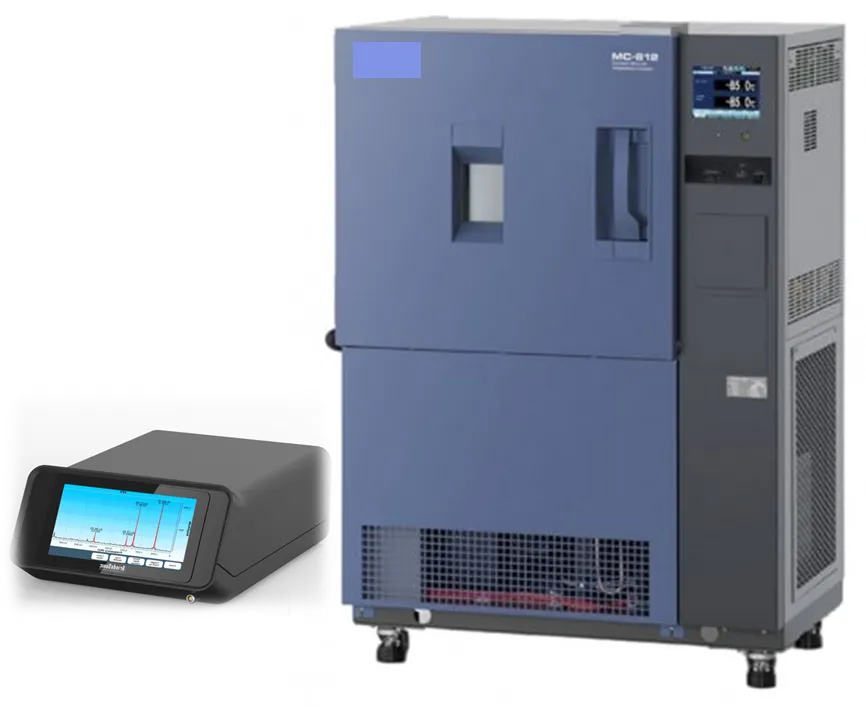
-85°C
Min Temperature
+180°C
Max Temperature
IET
Method
MK7
Compatible
LT85 Capabilities
Characterize materials across sub-zero and moderate temperatures with laboratory-grade precision.
-85°C to +180°C Range
Test materials from deep cryogenic temperatures up to +180°C with precise temperature control and programmable heating/cooling rates of 1–5°C/min.
Continuous Measurement
Monitor Young's modulus, shear modulus, Poisson's ratio, and damping throughout heating and cooling cycles at programmable intervals.
Programmable Profiles
Fully programmable ramping/dwelling temperature profiles with measurements taken automatically at configurable temperature or time intervals.
MK7 Integration
Seamless connection with MK7 electronics for data acquisition, FFT analysis, and advanced signal processing.
Electromagnetic Excitation
Automated impulse excitation system using an electromagnetic actuator that propels a ceramic pellet against the test object.
Thermal Expansion Compensation
Built-in expansion coefficient compensation increases measurement accuracy by accounting for dimensional changes under temperature.
Technical Specifications
LT85 chamber specifications
| Model | LT85 |
| Temperature Range | -85°C to +180°C |
| Method | Impulse Excitation Technique (IET) |
| Measurements | Young's modulus, shear modulus, Poisson's ratio, damping vs. temperature, natural frequencies |
| Heating/Cooling Rate | 1–5°C/min |
| Heating Elements | NiCr-strip heater |
| Cooling System | Plate-fin cooler with hermetically sealed compressor (R404A/R508A) |
| Atmosphere | Air (optional inert gas flow) |
| Chamber Height | 400 mm |
| Max Sample Length | 150 mm |
| Sample Loading | Front load |
| Excitation System | Adjustable height and positioning |
| Electronics | MK7 compatible |
| Standards | ASTM E1876, ASTM C1259, ASTM C1548, ASTM E2534, EN 843-2, EN ISO 12680-1 |
Applications
Ideal for materials tested at sub-zero and moderate temperatures
Polymers & Plastics
Glass transition detection, stiffness vs. temperature behavior
Composites
Carbon fiber, glass fiber performance across thermal cycles
Cryogenic Research
Material behavior at sub-zero temperatures for aerospace and energy
Metals & Alloys
Low-temperature ductile-to-brittle transition characterization
Need Testing down to -85°C?
Contact us to discuss your low-temperature requirements and application needs.